
The Root of the Root: We Can't Address Rape Without Addressing Gender Inequality
And we can't address external gender inequality until we are all willing to address our internal gender inequality.

If you’ve ever thought, “Is anyone else seeing this?”—join 30,000 readers for a well-researched dose of clarity (and solidarity) about the invisible power structures shaping our lives, delivered to your inbox every Sunday morning.
PS- I’ve got a little treat coming up for you this week that I’m so freaking excited about- details at the end of this post.
You know that advice given to writers to “kill your darlings” while editing?
What they don’t tell you is that sometimes your darlings come back from the dead to haunt you. Sentences arise from the grave with sad puppy dog eyes asking why you killed them.
Three weeks ago, my article about the root of the Epstein files went viral.
Which made my dead darlings whine all the louder.
Please indulge me in avenging their death.
When I re-read that essay, there are two areas that beg me to go deeper:
I mention that gender inequality lies at the root of the Epstein scandal, but I don’t explain how or why. I wish to draw the through line stronger about how gender hierarchy (both internally and externally) leads to sexual violence.
What we can actually do about it? (other than shake our fists at the sky and grumble “patriarchy” like a disgruntled sailor complaining about the weather.
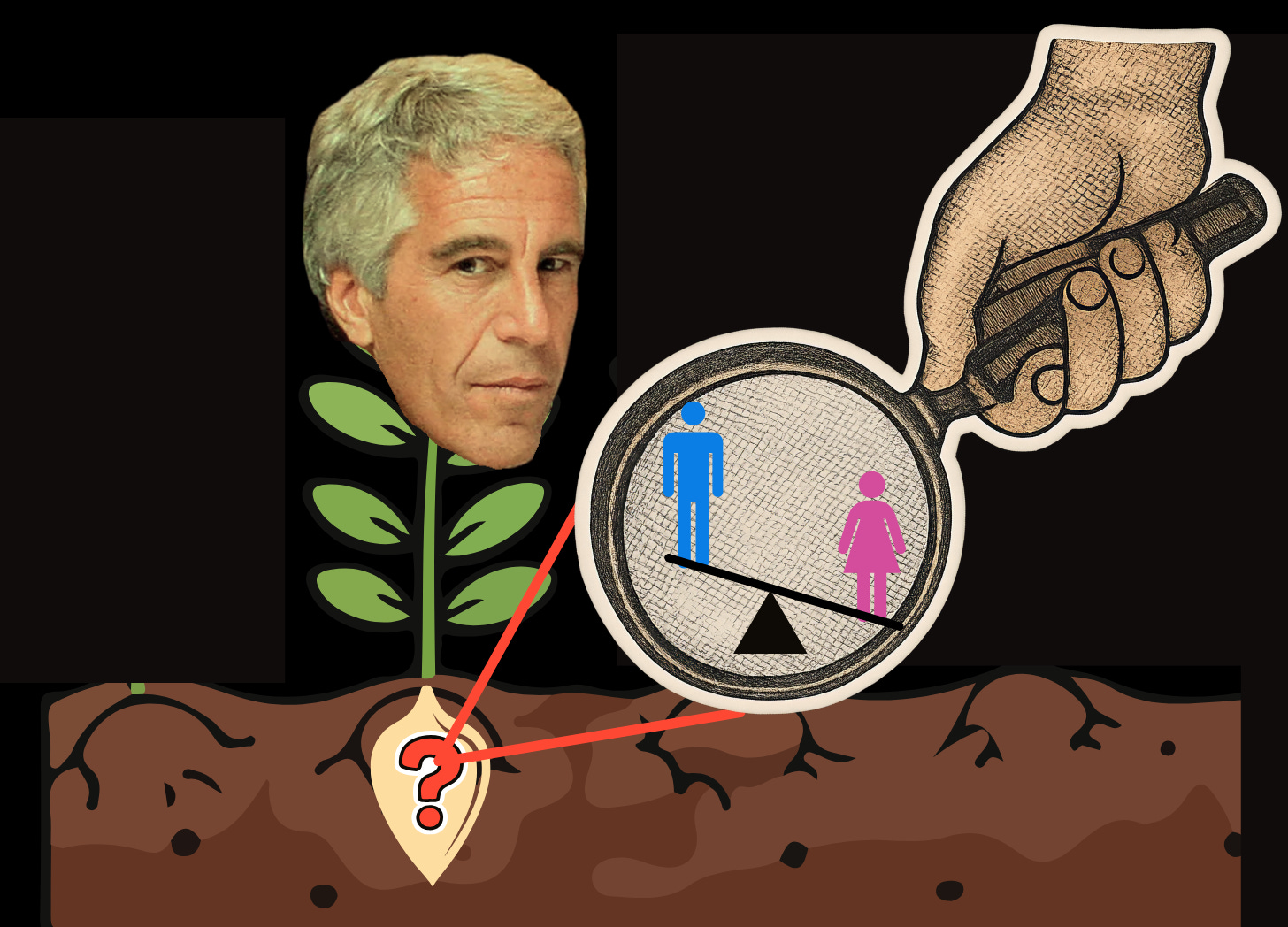
How gender inequality leads to sexual violence
To explain rampant inequality, some people assume humans are just a stinky, shitty bunch of dingus heads who will always act in our own self-interest.
But behavioral research suggests the opposite. Most people actually cooperate. We have this tendency to share resources and help strangers even when there’s nothing in it for us.1
How then, if we are mostly decent, benevolent creatures, do we end up tolerating such a longstanding, widespread imbalance of rights and resources across class, race and gender?
For oppression to flourish among otherwise considerate humans, those humans would have to participate in inequality without feeling bad about it. Without it affecting their sense of self.
How do you pull that off?
You chip away at the oppressed group’s humanity.
As James Baldwin observed, “All oppression is rooted in the tragic fact that man is capable of dehumanizing man.”
Philosopher Simone Weil put it this way, “Oppression proceeds by turning those subjected to it into objects.”2
Strip a woman of her interior life—her hopes, fears, passions, yearnings and shame—and reduce her to a collection of body parts.3 Tell both men and women that a woman’s primary value is linked to how she looks and how she serves men. Have everyone prioritize the opinions, desires and work of men above the opinions, desires and work of women.
That’s how you end up in a world where one in four women experiences sexual assault.
But the problem goes deeper than how we treat each other. It begins with how we are taught to treat parts of ourselves.
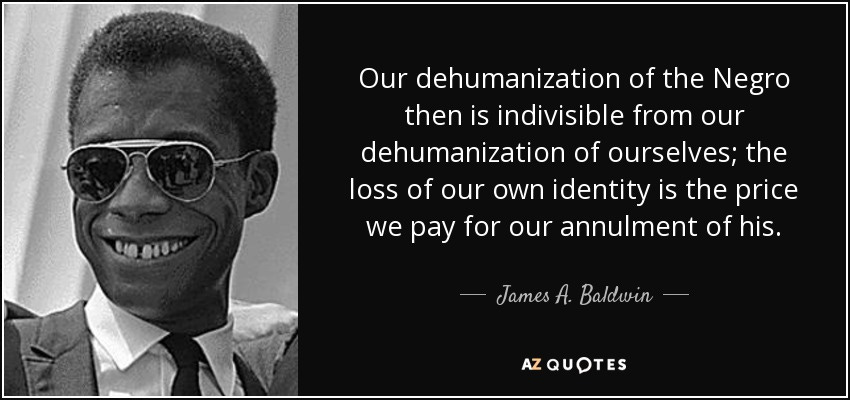
James Baldwin again explains that the dehumanization of others is inextricably linked to the dehumanization of ourselves:
Quick note before we continue: Throughout this essay I speak about “men” and “women” as if gender were a simple binary. It isn’t. But patriarchy functions by forcing people into that binary and ranking one side above the other. The analysis here focuses on how that over-simplified hierarchy operates.
Similarly, I do not believe that “masculine” and “feminine” traits are biological imperatives, but shifting societal norms patriarchy assigns to men and women.
How internalized gender inequality leads to the dehumanization of self
For our last Matriarchal Blessing book club, we read Terry Real’s I Don’t Want to Talk About It: Overcoming the Secret Legacy of Male Depression.
When I announced the book, someone messaged me saying, “In the age of Epstein, abortion bans and traditional patriarchal values being shoved down women’s throats, is it really the time to talk about male depression?”
To which I say, yes. It is.
Because the psychological engine behind male depression is the same engine behind Epstein, abortion bans and patriarchal values being shoved down our throats.
It’s the root of the root.
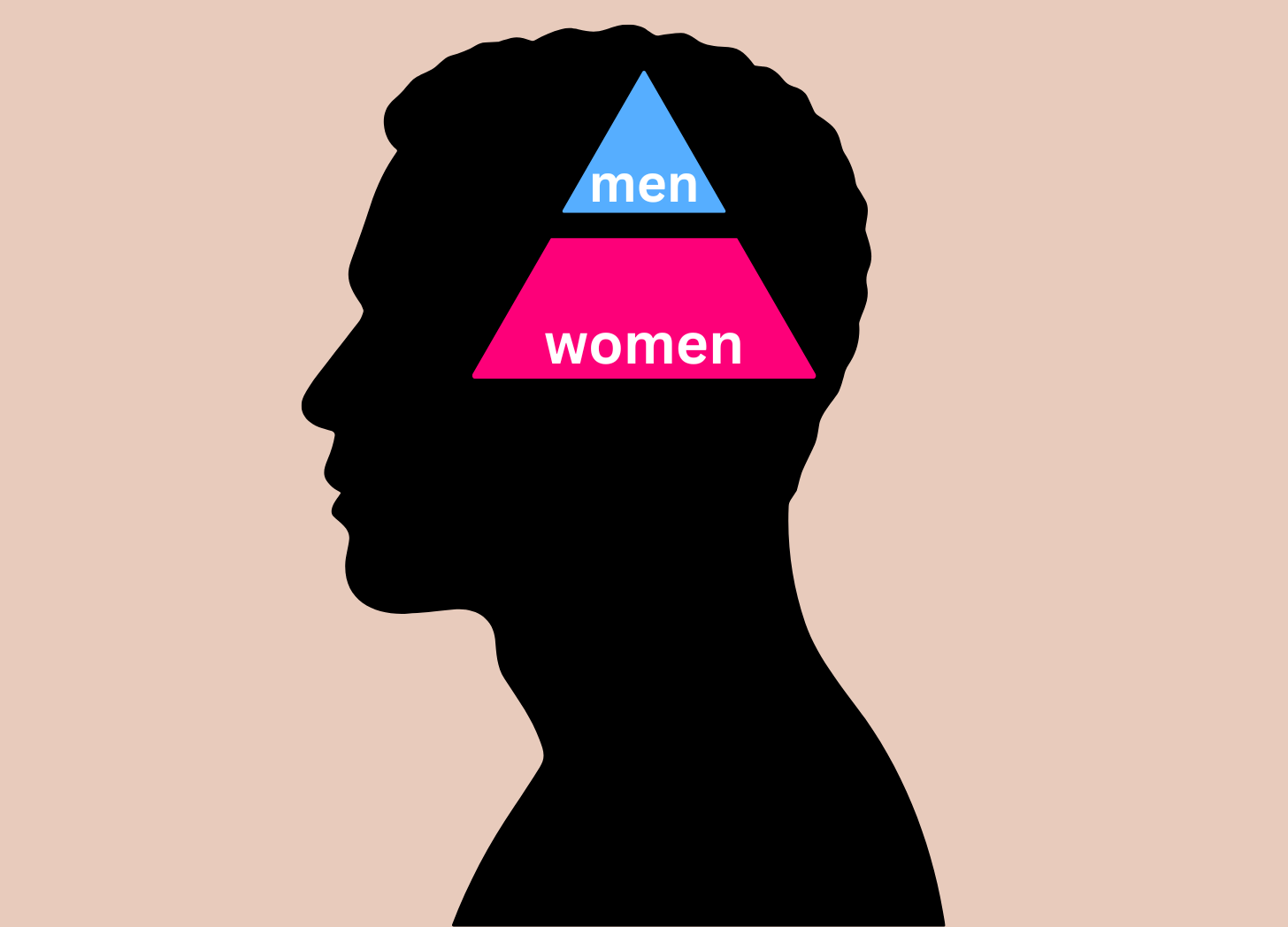
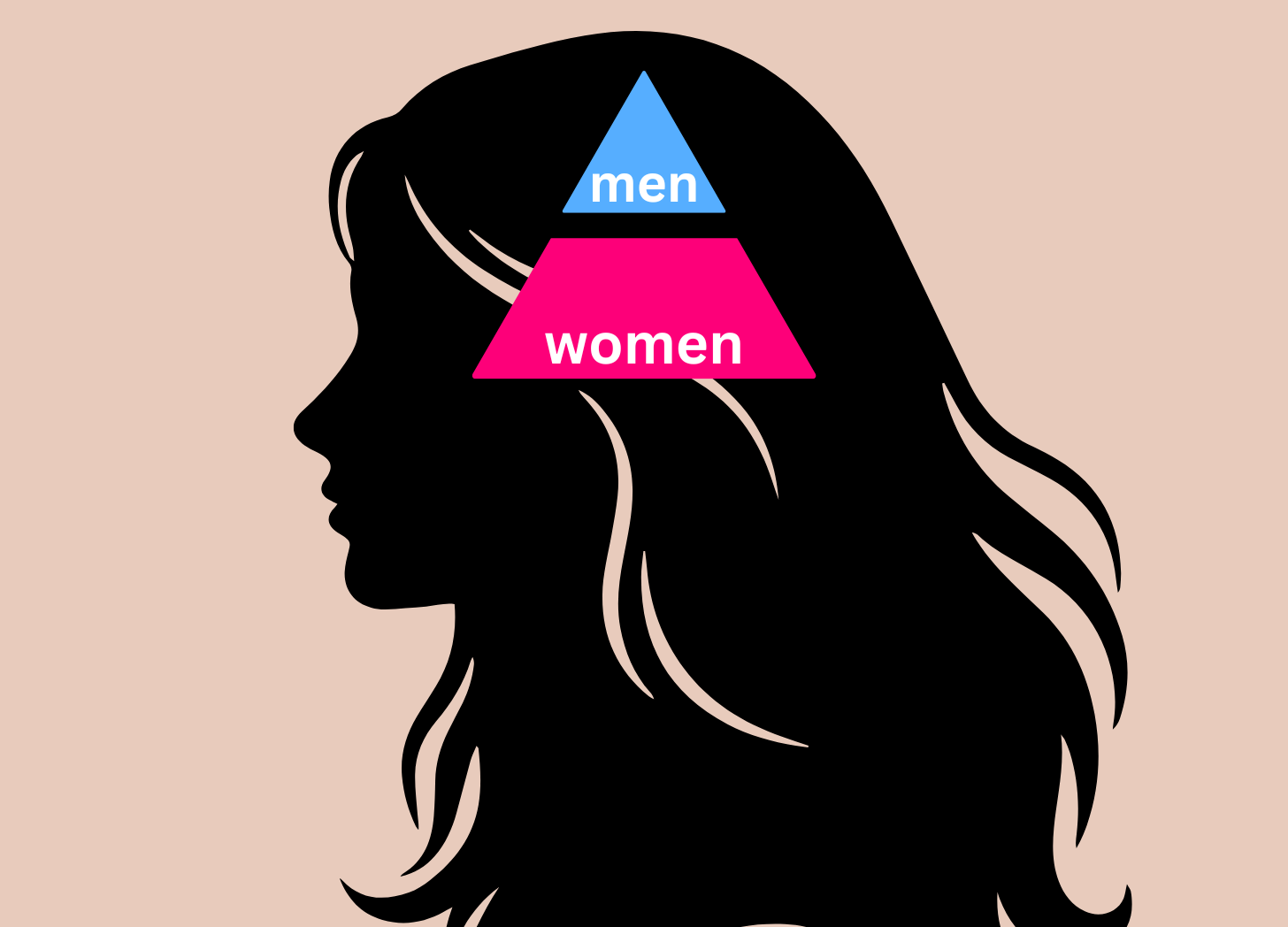
Gender inequality doesn’t just divide society; it divides the human psyche.
The most memorable passage for me of I Don’t Want to Talk About It was Terry describing one of his men’s group sessions when Terry was prompting one man to explain what happens in his inner world when he feels weak.4
He says he sees a small boy—sad and crying.
But no one can reach the boy.
Because circling him is a gorilla, pounding its chest and screaming at him:
“Toughen up, you weak little pussy.”
The gorilla never stops. It shames the boy into silence until the boy hardens into a “man”—stoic, tough, invulnerable.
In other words: before men learn to dominate others, they are first trained to dominate themselves.
It reminded me of a comment a man left explaining his inner dialogue before sharing one of my articles about patriarchy:
“…As I moved my thumb to ‘like’ this post, I found myself hesitating, my thumb hovering millimeters away from the heart icon in the lower left corner.
As I paid closer attention to this moment of hesitation, I discovered a dude lurking in the recesses of my consciousness, warning me away, threatening me if necessary, to avoid being seen as some sort of kiss ass, or cuck, or traitor.
Even as I write this post, he shakes his head in disappointment. They’ll be coming for you, he says, any time now. You should’ve kept your head down and your mouth shut.
I’m a man who likes women. I’m a man who fears being seen as less than a man. These primal and cultural forces war within me....”
That internal war is not incidental to gender inequality. It puts internalized inequality on display.
The really insidious thing about gender inequality is that it teaches men to not just dominate women, but to dominate those parts of themselves that act “like women”—weak, soft, vulnerable, communal, dependent.
As within, so without.
As Terry Real describes,
“What our sons internalize is that women and woman-ish things including half of the boy’s own being are held as inferior. Recovery comes when a man learns to embrace, remember and cherish his own full humanity.
This is neither an easy nor popular task. Society rewards self-objectification in men. It gives men privilege. It reinforces their superiority. And it shows little mercy for men if they fail in their performance of the role. But the price of that performance is an inward sickness. Any substantive healing must address that inward sickness.”
The same system that teaches men to pay no heed to the crying boy inside them also teaches them to pay little heed to the women outside of them.
The system that teaches men to value their “masculine” qualities above their “feminine” ones is the same system that teaches all of us that men matter more than women.
Gender inequality doesn’t just dehumanize women.
It first teaches men how to dehumanize parts of themselves.
“For many depressed women, recovery is inextricably linked to shedding the traces of oppression and finding empowerment, for many depressed men, recovery is linked to opposing the force of disconnection and re-entering the world of relationship—to the feminine, to themselves and to others. - Terry Real
How do we uproot it?
Many of you responded to the Epstein article with “That’s nice, but what can we actually do about it?”

One comment from @John Gill particularly nudged me to write this article you are reading now:
“Yes I totally agree with this analysis. There is no way to address the root causes of any problem without first examining how we are personally implicated. However I worry that naming the problem “patriarchy” is a little too impersonal — an abstraction. As soon as we agree on the use of that word an escape hatch opens up and individually we become absolved. When it comes to taking action, we risk chasing ghosts instead of addressing the root causes…
So my challenge to your readers and myself and maybe you if you are still digging/gardening this topic is: How would you describe the problem as one you personally own? How are you personally implicated in keeping it in place? Then we might get closer to the deeper roots.”
I agree.
Nodding wisely saying, “yes yes, patriarchy” *vaguely waves at the wind* is the problem. We get it.
Pointing fingers is fun. It makes us feel morally superior and gets lots of attention online.
Pointing fingers is not going to get us out of this mess.
Things will only change when a whole lot of us are willing to take personal responsibility to uproot gender inequality in our own lives.
Starting with our own heads.
Here’s a list of questions to get us going.
For the male-identifying folk:
How do you treat the parts of yourself you consider weak, soft, or emotional?
When was the last time you expressed grief, fear, or vulnerability to another person? How comfortable did it feel?
Do you feel embarrassed being seen enjoying things culturally labeled “girly”? Why?
What proportion of the voices you learn from—podcasts, books, music, teachers—are women?
When women speak in a group, how often do you feel curiosity versus skepticism?
Do you listen to women in your life with the same seriousness you listen to men?
Are there emotions you feel permitted to express publicly, and others you feel you must hide?
When a woman sets a boundary with you, do you experience it as information or rejection?
For the female-identifying folk:
When you picture authority, expertise, or leadership, whose face appears first in your mind?
Do you ever soften your opinions, humor, or intelligence to keep the peace?
How often do you prioritize other people’s comfort over your own truth?
Do you feel guilty when you inconvenience, disappoint, or upset others?
Are there desires or ambitions you’ve quietly minimized to avoid seeming selfish or difficult?
When a man and a woman disagree, whose judgment do you instinctively trust more?
How often do you find yourself managing the emotions of the men around you?
Do you feel responsible for maintaining harmony even when it costs you something?
This week I read a lovely article by Alexandra Winteraven (they) called “The Matriarchy Fantasy Feels Like a Sedative” where they ask:
“What are you actually willing to destabilize?
What are you actually willing to disrupt in your life?
What are you actually ready to confront around identity, role, and how you are seen?
Not in theory. Not in a comment thread. Not in a vision of a future society. Not in a book club discussion. Not in a podcast conversation. Not in slogans.
In your real, actual life.
That is where power can actually begin to shift on a structural level.”
Amen. That’s how stuff changes—not through vague, amorphous blame, but with lots and lots of individual change and accountability.
Gender inequality is the root of so very, very many of our problems.
And to dig up the root of the root—we have to start digging at the gender inequality inside our own minds.
I’m so stoked to announce that I will be joining Terry Real (yes, that Terry Real I’ve been quoting all article) and Lissa Rankin, MD in a free webinar call this Thursday, March 19 at 9:00am- 10:30am PT. It’s called “After Epstein: A Community Conversation on Betrayal, Silence, and Healing” and you are all invited to listen and join in the conversation.
Register here. Hope to see you there!
Want to root out the patriarchal hierarchy in your own head? Cool me too. Our next Matriarchal Blessing book club book is going to help us do exactly that. The book is The Patriarchs: The Origins of Inequality by Angela Saini. We will meet April 19 at 11:00am PT to discuss it (registration link will come closer to meeting). Join us by becoming a paid subscriber.
Alternatively, you could also just pay me for my work simply because you appreciate it and want to see it continue, that would be so lovely of you! Thank you!
Like this Cornell study that found, “Contrary to the predictions of the widely used inequity aversion models, we find that benevolence does exist and a large majority of people behave this way.”
Brene Brown explains it this way: “How does this happen? Maiese explains that most of us believe that people’s basic human rights should not be violated—that crimes like murder, rape, and torture are wrong. Successful dehumanizing, however, creates moral exclusion. Groups targeted based on their identity—gender, ideology, skin color, ethnicity, religion, age—are depicted as “less than” or criminal or even evil. The targeted group eventually falls out of the scope of who is naturally protected by our moral code. This is moral exclusion, and dehumanization is at its core.
Dehumanizing always starts with language, often followed by images. We see this throughout history. During the Holocaust, Nazis described Jews as Untermenschen—subhuman. They called Jews rats and depicted them as disease-carrying rodents in everything from military pamphlets to children’s books. Hutus involved in the Rwanda genocide called Tutsis cockroaches. Indigenous people are often referred to as savages. Serbs called Bosnians aliens. Slave owners throughout history considered slaves subhuman animals.”
obsessively, relentlessly judging, weighing, rating women’s attractiveness is a good way to do this
I don’t have exact quotes because I listened to the audiobook from my library, but I’ll describe how that scene went down to the best of my memory.
Excellent post as always!
Male-identifying person here, offering another question for the list (especially for the men here, subscribing to a feminist newsletter):
"Do you treat other men in your life with the same kindness, tenderness, playfulness, curiosity and compassion that you treat women with?"
It's not only that men treat women in sexist ways, it's also that they treat men in sexist ways. And for progressive men who put in the work over the last decades to engage with feminism, I'd say that it's likely they are more sexist towards men then they are towards women. I definitely notice that in myself. (I'd wager this is also true for a lot of progressive women tbh - see Ruth Whippman's book for more on this)
When it comes to taking personal responsibility for gender equality, I honestly think that one of the most important things right now is for men to support and scaffold each other in healing from patriarchy. Even when we call each other out on problematic behaviour, and we should, that should come from a place of "Your humanity has been neglected and warped by patriarchy and turned into this. I'm sorry. You always deserved better. Let us heal together." rather than just a condemnation of the behaviour that doesn't treat the foundational patriarchal wound that caused the behaviour to begin with. (So not a good men / bad men dichotomy, which is way to common as a frame and one I've succumbed to in the past myself)
Healing from patriarchy is not something a man can do by himself. Nobody can, of course, but for men it's more important to emphasize the point.
One thing leaving a high-control religious system made very visible to me is how early this internal hierarchy gets trained into people. Women are taught to anticipate needs, manage emotions, soften conflict, and prevent discomfort long before we ever notice we’re doing it.
It becomes so automatic that many of us mistake it for love or virtue rather than a learned survival strategy.
It has taken years since leaving Mormonism for me to even recognize this pattern in myself, let alone start rooting it out.