
So sorry, but your New Year's Resolutions won't make you healthier or happier.
On the wide mismatch between what we think will make us happy and healthy and what actually does.

There is an incredible mismatch between what we reach for to be happy and what has been shown to actually make us happy.
In 1938, Harvard researchers wanted the answer to the question, what is the most important contributor to human happiness? They interviewed hundreds of participants from all around the world and followed up with them every two years; recording their incomes, health records, relationship statuses, air quality and dozens of other metrics.
85 years later and the same study is still on-going. And what have they found to be the #1 most important indicator in predicting someone’s life long health and happiness? Is it diet? Fitness? Air quality? Wealth?
No.
It’s the strength of their relationships.
 Tiktok failed to load.
Enable 3rd party cookies or use another browser
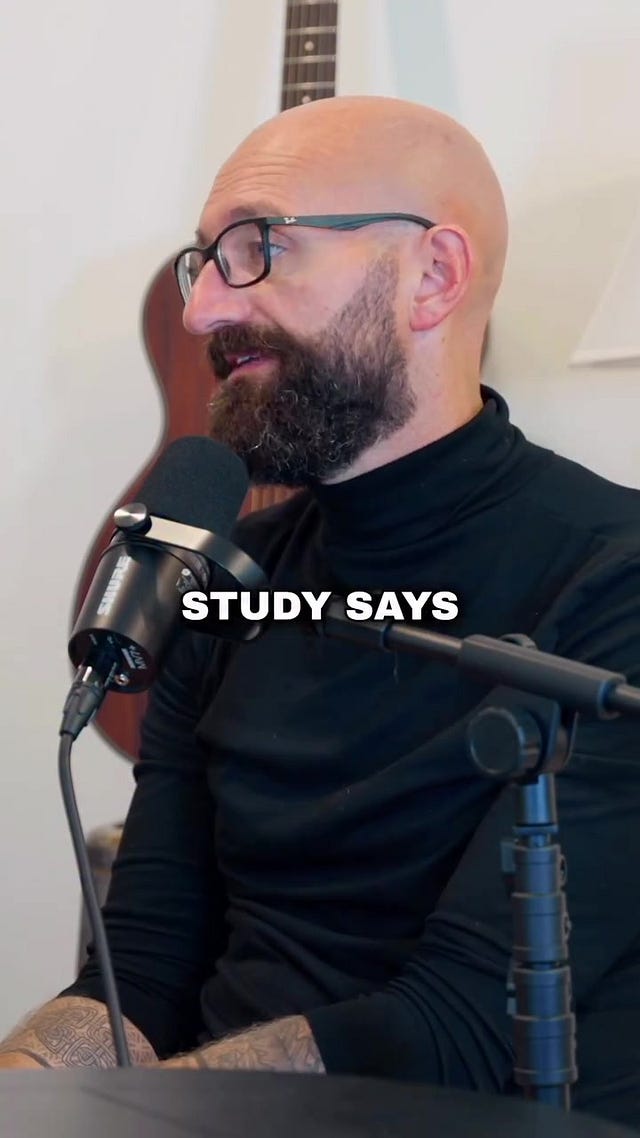
"Harvard's longest longitudinal study says... that the people who live the best lives, the most fulfilled lives weren't the ones who made the most money, they weren't the ones that stayed the healthiest, they weren't the ones that exercised the most, they weren't the ones with the best jobs… the greatest social status, they were the people that had a thread line of meaningful connection relationally throughout the tapestry of their life.” - Dr. Adam Dell
To live a long, healthy fulfilling life, we need people. We need strong relationships. We need community.
So, when it comes to making New Year’s Resolutions, surely the most common goals are strengthening existing relationships, making new friends, inviting neighbors over more, going to more community events, volunteering?
Alas, no.
According to Statistica, the three most common New Years Resolutions of 2025 were:
save money
eat healthier
exercise more
lose weight
Hm, correct me if I’m wrong, but none of our most common goals involve other people at all.
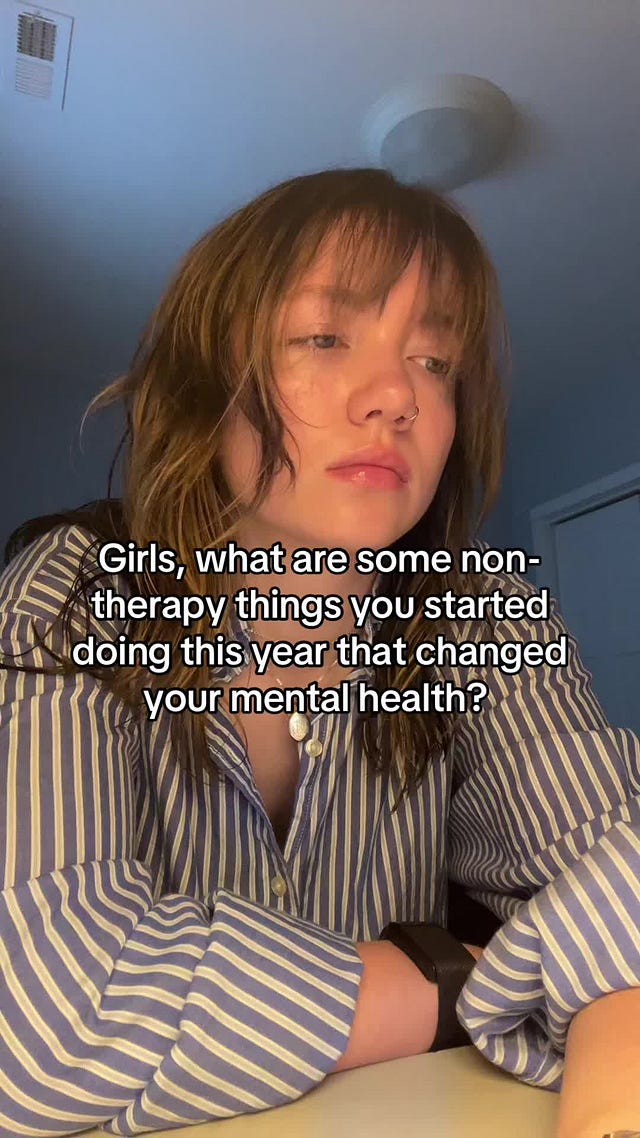
I came across a TikTok recently that asked, “Girls, what are some non-therapy things you started doing that changed your mental health?”
 Tiktok failed to load.
Enable 3rd party cookies or use another browser
A whopping 77,475 comments have responded to the prompt.
I did not read all of them, but I did scroll through the comments for 16 minutes.
There were lots of good suggestions—lots about diet, exercise, spending habits and thought management.
But since I had freshly read about that 85 year Harvard study about what actually makes us happy, I was on the lookout for anything about community, friendships, or forging connections.
I was surprised by what I found. Or rather what I didn’t find.
Out of the thousands of comments I read, guess how many mentioned gathering with other humans at all?
Three!
Only 3!
One said spending time with family, one said making plans, another said getting together with friends every week.
No shade to diet and exercise, but when those are the only things we reach for when we want to improve our lives, they are severely lacking.
Ironically, according to that Harvard study, strong relationships don’t just make you happier than diet and exercise, strong relationships make you healthier and extend your life more than diet and exercise do.
Yet forging stronger relationships and community do not rank in our top New Year’s Resolutions.
As someone who used to teach marriage courses for the Gottman Institute, I’m quite familiar with this study as John Gottman is very fond of quoting it and saying, “Working briefly on your marriage every day will do more for your health and longevity than working out.”
Even when measuring the happiness in countries, relationships are the strongest metric. In The World Happiness Report 2025, a mammoth research study compiled by Oxford, Gallup and the UN, this is the table of contents of their report
Chapter 2 Caring and sharing: Global analysis of happiness and kindness
Chapter 3 Sharing meals with others: How sharing meals supports happiness and social connections
Chapter 4 Living with others: How household size and family bonds relate to happiness
Chapter 5 Connecting with others: How social connections improve the happiness of young adults
Chapter 6 Supporting others: How prosocial behaviour reduces deaths of despair
Chapter 7 Trusting others: How unhappiness and social distrust explain populism
Chapter 8 Giving to others: How to convert your money into greater happiness for others
Sharing meals, connecting with others, giving to others, supporting others- these are the things found to make countries happier. These are the things that make individuals in these countries happier.
Every single metric mentions other people. And yet what do we reach for when we’re sad?
Here’s another TikTok trend I’ve seen replicated dozens of times:
 Tiktok failed to load.
Enable 3rd party cookies or use another browser
“Why do I feel so sad today?”
"Have you eaten?” “No.”
“Have you drank any water?” “No.”
“Have you done any work?” “No.”
“Have you done any hobbies?” “Laid in bed...”
“I don’t know what the issue is.....”
Here’s another one in that same format that starts out “I’m feeling really down these days and I don’t know why.” “Well did you exercise today?”
These are silly little sketches, but also such spot on depictions of what conclusions we draw when we are down… I’m sad because I didn’t exercise, eat right, drink enough water, or work enough.
When it comes to healthy habits and forging community- this is not an either/or scenario, it’s a both/and. We can have healthy goals and build community. But when community enters the equation only 3/1000ths of the time, the both/and isn’t happening.
Strong connection with others is the #1 predictor of happiness, but again and again and again, we reach for self-optimization instead.
There is a big, fat, wide, gaping hole called “community” that we should be reaching for when we’re sad, down, low, but instead we beat ourselves up that we aren’t more self-actualized.
I’ve fallen for this more times than I can count. Just like those TikToks, when I’m feeling sad or lonely, my first instinct is to reach for self-optimization to solve the problem. I just need to exercise, eat better, gratitude journal, work harder, get more sleep, meditate, make art.
If I could just accomplish that perfect body, perfect house, perfect job, perfect schedule, then I’d be happy.
A big fat hole in our model for human fulfillment

This is Abraham Maslow’s model of our hierarchy of needs. Written in 1943, but still used widely today as an assessment tool in education, health care, social work and kitschy Substacks, this model has been a north star for human fulfillment for the past 80 years.
And sitting atop the throne, what is the crowning jewel we are all working towards? SELF actualization. Note the lack of the word “community” anywhere on the spectrum of human needs, even in the “love and belonging” section.

After publishing his work, Abraham Maslow wanted to observe other cultures to ensure his theories on human needs were universal, so he went to live with the Blackfoot tribe in Montana and Canada.
Only, the Blackfoot tribe did not prove his theories correct. Instead of striving for self-actualization as an end goal, for the Blackfoot, that was the starting line. Researcher Ryan Head said this of Maslow’s visit:
“[Maslow] estimated that “80–90% of the Blackfoot tribe had a quality of self-esteem that was only found in 5–10% of his own population.”
Wow! What an incredible finding.
Why was this?
Was it because the Blackfoot people had mastered their macro counting? Did they lift heavy weights and get their 10,000 steps? Did they cut out sugar and carbs, master their protein intake and achieve their dream bodies??????
Weirdly Maslow did not mention the nutrition or exercise habits of the Blackfoot while commenting on their happiness. Except to say that they all had “full bellies.” Here’s what he did say:
“...he did not see the quest for dominance in Blackfoot society. Instead, he discovered astounding levels of cooperation, minimal inequality, restorative justice, full bellies, and high levels of life satisfaction.
Eventually Maslow realized the gaping hole in his theory: community. (Two of my other favorite topics of human thriving also made the list: lack of dominance and equality) Twenty-three years after he published his hierarchy of needs he wrote:
“…self-actualization is not enough. Personal salvation and what is good for the person alone cannot be really understood in isolation. The good of other people must be invoked as well as the good for oneself. It is quite clear that purely inter-psychic individualist psychology without reference to other people and social conditions is not adequate.“ - Abraham Maslow
Unfortunately, this writing was never published (largely because of racism) and we’ve been left with self-actualization as the ultimate goal instead of community-actualization.
But man, how different would the Western world be if for hundreds of years we dreamed of community fulfillment instead of self fulfillment?
Instead in the west, we’ve hailed this idea of individualization, independence and self optimization as the height of progress. And urged other “third world” countries to do the same.
Meanwhile, we are all lonely and depressed. And then instead of realizing, “Well, duh, we need a village, but we’ve moved away from tight-knit villages into these individualistic isolated islands where we try our best not to ask anything of anybody.” Instead of that, when we’re sad we’re told to make more money, buy more things and exercise more.
Trevor Noah nails it:
 Tiktok failed to load.
Enable 3rd party cookies or use another browser
“The thing you are sold in developed nations is that you have everything. Oh it’s great- the roads work and the schools are fantastic and there’s healthcare, this is a great country to be in…. The one thing that nobody seems to tell you is that as a country becomes more and more developed, the thing that gets eroded is community.
The village disappears.
And what you have to do is you have to buy the village back… You have to buy somebody to look after your kid. You have to buy somebody to help you clean your house, cook your food…
You are buying the same village they tricked you into not having…” - Trevor Noah
Who actually benefits when we obsess over self-optimization?
Billionaires.
So very many corporations and industries have a vested interest in us 1. Remaining isolated and 2. Blaming ourselves for all of our problems.
This keeps us on the merry-go-round of shame and consumption-as-solution-to-shame that corporations benefit from so much.
The weight loss industry is a $305 billion dollar industry. They very much want us fueled by our own insecurity, blaming ourselves for our unhappiness.
“Anti-aging is the ultimate capitalist goal, because it can never be met. It’s physically impossible to anti-age. And to try to anti-age is to be a consumer for life.” -Jessica DeFino
Netflix doesn’t want us going out with people and talking to them, they want us binge watching. Amazon doesn’t want us going out in public getting our goods locally, they want us at home, buying everything from our phone.
Facebook and other social media companies don’t want us to get our social interactions in real life, they want us to rely on them to get our social interactions.
Dating apps don’t want us to meet people without them. Uber doesn’t want us calling our friend to pick us up from the airport. Target doesn’t want us borrowing clothes or physical items from our friends.
There are trillions of dollars with a vested interest in keeping us from forging community and relying on each other. Capitalism feeds on loneliness and insecurity. It tells us the solution to our problems isn’t community, it’s consumption.
We must stay on our toes not to fall for it.
Tight-knit communities and mutual aid would shake the foundations of our isolated, individualistic, capitalistic society.
But to get there, we have to catch ourselves when we think self-optimization will solve all of our problems—catch those voices that say, “I’ll make friends once I lose 30 pounds.” “I’d be happy if I could just figure out how to be more productive.”
We’ve been sold a lie that obtaining that ever elusive perfect body, perfect home, perfect schedule are what brings happiness. But we don’t need a perfect schedule or perfect body more than we need community.
Hyper focusing on diet and exercise keeps our focus stuck on self-surveillance, guilt and individualism—a perfect distraction from our deeper human needs: relationships, care and community.
“Dieting is the most potent political sedative in women’s history.” - Naomi Wolf, The Beauty Myth
This constant attention on what we ate, how much we exercised, whether we were “good” or “bad” with our bodies- this all takes enormous emotional and cognitive energy. It zaps all our bandwidth so we have little left for the things that actually would bring joy and fulfillment- building deep friendships, caring for others, creating shared rituals or spaces, organizing for collective good, resting, playing and dreaming.
Then when we DO get around others, we’re so preoccupied with insecurity that we can’t actually glean the benefits community provides.
Double whammy.
Obsession with diet and self-optimization isolates us, keeping us inward-focused and disconnected.
We live in a world that has convinced us to treat our bodies as problems to be solved, instead of instruments of connection. And in doing so, it has robbed us of the very things that would nourish us: intimacy, community and collective joy.
Isn’t this Substack about patriarchy? What does community have to do with patriarchy?
Everything.
The opposite of patriarchy isn’t matriarchy as defined by women ruling over men—the opposite of patriarchy is community.
"Capitalism and patriarchy together, as structures of domination, have worked overtime to undermine and destroy the larger unit of extended kin."- bell hooks
Community and equality are the antidotes to patriarchy.
For the next few weeks we are going to discussing community—how to build it and how it is the answer to deconstructing patriarchy.
I hope you’ll join us.
In the mean time, if you feel like setting some goals for the New Year that will actually bring health and happiness- consider resolutions around forging stronger relationships and stronger community.
Do you like discussing all things patriarchy and feminism? Cool me too! Our next zoom discussion will be Sunday January 25th at 1:00pm and we will be discussing I Don’t Want to Talk About It: Overcoming the Secret Legacy of Male Depression by Terrence Real. Join us by becoming a paid subscriber!
Alternatively you could just become a paid subscriber to support my work, in which case may your Starbursts always be pink, may your toddler eat that piece of toast in its entirety and may that new show you want to watch be on the streaming service you already pay for. Blessings be upon you.
So appreciating this, Celeste, and the very necessity of community as the antidote to patriarchy and capitalism. That said, something else I've been thinking a lot about is unwinding my own self enough to be able to contribute to community in a way that is uniquely me and standing in my own wholeness and power. Without trusting my own voice and valuing my own contributions - even if they go against the group - I've had the experience of being subsumed by community because I did not want to risk my own belonging. Very much a both/and, and as a (white) woman, something I'm still feeling my way through. I, and many of us, have been conditioned to be agreeable people pleasers, which can lead to self-erasure when we get in group settings, or - on the flip side - enforcing our own value set on others. There's so much baggage in the system itself that needs to be sorted through, and that can be very individual work. I recently finished reading "Waking up White" by Debby Irving, which really brought a greater understanding and sobriety to what is necessary if we really want to forefront equality.
Thank you Celeste! This is the New Year’s push I need to replace my current one which was of course to lose weight! I tend to draw into myself when I’m down, but seeking out time with others is really what I need, as difficult as it can be to make myself do it. Also, there was a meme that was going around that said, the reason Americans loved their college experience so much was because it was the only time they lived in a walkable environment. I have been trying to minimize my car use, and I find I run into so many more neighbors, and feel so much more connected to my community just through walking around my neighborhood. 🥰