
Keep posting about your embarrassing boyfriend please
Is having a boyfriend embarrassing? Or is gender inequality embarrassing? And is gender inequality now being exposed on a global scale?

Do you enjoy thinking about and discussing all things patriarchy and feminism?? Cool me too. Come discuss with me and the Matriarchal Blessing community by becoming a paying subscriber. For our next gathering we will be discussing I Don’t Want to Talk About It: Overcoming the Secret Legacy of Male Depression by Terrence Real together in January.
Two weeks ago Vogue came out with an article called “Is Having a Boyfriend Embarrassing Now?” by Chanté Joseph.
Let me say that again.
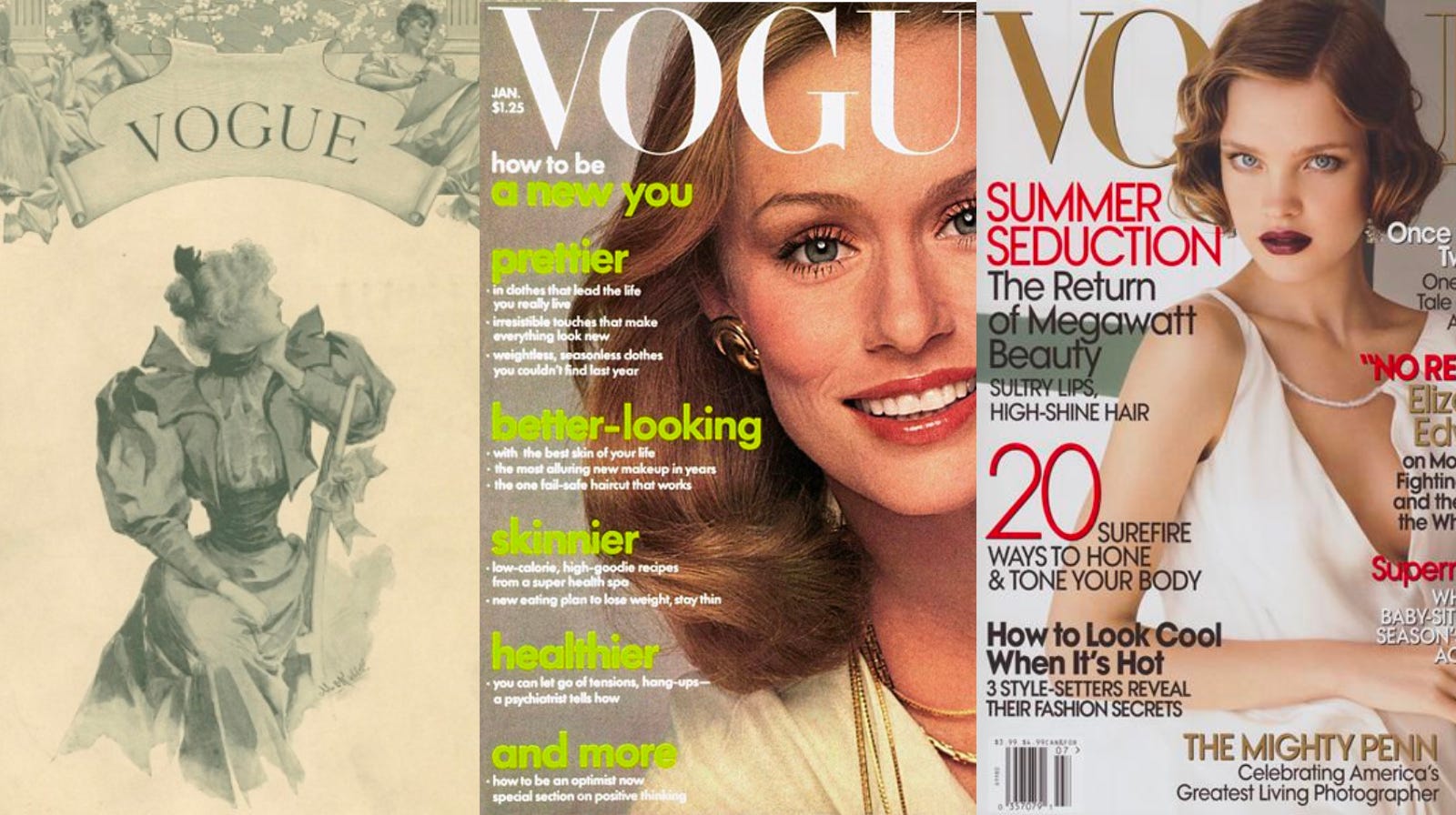
Two weeks ago, Vogue, as in “6 date night outfits sure to wow your man” Vogue, as in “How to give a better blow job” Vogue, as in a steady stream of 130 years of “how to be prettier for men” articles—that Vogue—came out with an article called, “Is Having a Boyfriend Embarrassing Now.”
The article has gone crazy viral. It’s been covered everywhere from USA Today to CNN, and even newly elected NYC mayor Mamdani was asked to weigh in.
The article itself is kind of a big deal.
It would be an even bigger deal if it were true—that having a boyfriend no longer gives women social status.
I’m skeptical, but let’s take a minute to entertain the significance of this moment in history if it were true.
If it were true that being chosen by a man now diminishes a woman’s status, this would mark a rupture from a centuries-long precedent where a woman’s social standing has been dictated by male selection.
From earliest written records in Assyria to ancient Rome all the way to the coverture laws of the 20th century—women had no legal standing, property access or respectability prestige except through marriage.
Remaining unchosen was cause for pity, disrespect and suspicion (what’s wrong with her?).
If now being chosen by a man in fact diminishes a woman’s social standing, that wouldn’t be just a small cultural change, that would be the collapse of a millennia-old social hierarchy.
We may be exposing some chinks in this social system, but I’m not sure we’re quite at the point of patriarchal collapse quite yet.
It does in fact still bring women social status to be chosen by a man.
As someone with a daughter in high school, I’m so sorry to report that the popular girls are still the ones with boyfriends. Being chosen by a boy is still a status symbol. It’s still embarrassing not to get asked to prom or homecoming.1
Our media is still saturating us with the fantasy of being chosen by a boy. The most popular show on Amazon Prime this year for girls aged 18-34 was The Summer I Turned Pretty, a show about a young woman finally attracting her crush(es).
The most popular pop song right now is The Fate of Ophelia by Taylor Swift, a song about a man saving her from her dreaded fate of being single: “No longer drowning and deceived, All because you came for me.”
The Vogue article references a Substack article called Boyfriendland that started keeping track of just how many TikTok trends’ purpose is to show off male partners:
“…over half of the trends that go viral end up being co-opted by people showing off their male partners. I made it a point to point out how few trends are men showing off their girlfriends or wives: 99% of the time, it’s women showing off their boyfriends or husbands. I was keeping a 2024 tally and I eventually just gave up sometime in March: at this point, the app is the patriarchy itself.
I say all of this to hold up a mirror to society: I understand that there are more women on social media than men, and that for a certain segment of society, having a boyfriend or a husband is quite literally the most important thing you can do.” - Tell the Bees
So yes, elevated status due to boyfriend is still alive and well.
Which these days, doesn’t actually make all that much sense. Scientifically speaking, women should in fact have very little incentive to seek out boyfriends or husbands.
Multiple studies have shown that single women live longer than married women. Married women also earn less money while doing more unpaid labor than single women. They also get less sleep, less exercise, are more likely to be depressed, less likely to be sexually satisfied and more likely to die from stress-related diseases, suicide or homicide.
So on the whole, women aren’t getting health, happiness or sexual satisfaction out of long-term relationships with men, and now that women can financially provide for themselves, what on earth would entice so many women to not only desire boyfriends, but be so anxious to let everyone know they’ve got one?
Status.
The status quo.2
Relationships are still that mark in our society of being ok, being normal, being worthy. There is still that stigma of ‘what’s wrong with you’ stinging single women, left over from the past few millenia.
The single stigma isn’t as bad as it was generations ago perhaps, but it’s definitely still kicking around.
Blythe Green recently posted common things she is told as a 32 year old woman who has never been in a relationship: “you must not want one,” “you’re too intimidating,” “you’re not putting yourself out there enough,” “I don’t understand how someone like you is single.”
Always the assumption that having a boyfriend is the prize. And she’ll get that prize someday too if she just wants it bad enough, shrinks herself down and puts herself out there.
The Vogue article doesn’t so much make the point that having a boyfriend is embarrassing, as it does that posting about your boyfriend is now embarrassing.
That’s an important distinction.
Joseph says, “women don’t want to be seen as being all about their man, but they also want the clout that comes with being partnered.”
“…there’s been a pronounced shift in the way people showcase their relationships online: far from fully hard-launching romantic partners, straight women are opting for subtler signs—a hand on a steering wheel, clinking glasses at dinner, or the back of someone’s head.”
They still want to showcase that they have a boyfriend, they just don’t want to showcase the boyfriend himself.
Why?
The article goes on to say that boyfriends are, well, embarrassing.
“I don’t think I will ever post a man,’ says Nikki, 38. ‘Even though I am a romantic, I still feel like men will embarrass you even 12 years in, so claiming them feels so lame.”
“Boyfriends are out of style. They won’t come back in until they start acting right.”
So in essence, having a boyfriend is still in, but exposing the gender inequality you submit yourself to in a heterosexual relationship is out.
Having a boyfriend isn’t embarrassing, gender inequality is embarrassing
In our #girlpower, #bossbabe era, girls grow up hearing they can have anything they want, anything a man has. And in many ways, that is turning out to be true. More women than men now go to college and have advanced degrees. More single women are buying houses than single men. But when it comes to equality in their relationships? Well, turns out women can have anything they want, except that:
Even when wives earn more money than their husbands, they still do more childcare and housework while their husband has more leisure time.
Studies show that women overwhelmingly do more of the emotional and logistical work of maintaining a relationship: initiating hard conversations, organizing date nights and vacations and going to therapy.
Women are more likely than men to relocate for their partner’s job.
Heterosexual sex is more likely to center male desire, and women are more likely to sacrifice to maintain sexual harmony in a relationship.
And that is embarrassing. It is embarrassing to have on public display just how unequally women are treated in heterosexual relationships. Patriarchy is embarrassing. Inequality is embarrassing.
But just because it’s embarrassing doesn’t mean we should hide it.
I’m not sure not posting about boyfriends is the the harbinger of progress it’s being hailed as.
If having a boyfriend is still in, but exposing anything about their harmful behavior is out, aren’t we dialing back the clock of progress?
Going back to a time where a woman was all too happy to send out those wedding invites, but kept the fact that her husband treated her like a child a secret. Even to her closest friends and relatives.
I actually think it’s a mark of progress to open women’s eyes on a mass scale—for women to speak to each other honestly and openly about what it’s like to be in a relationship with a man, both the good and the bad.
We are living in an unprecedented time, not because patriarchy is going away, but because we’ve never had such a bright spotlight on it before
Let’s zoom out.
Before social media, our ability to have collective conversations on a national or global scale was dependent on 1. The publishing industry: books and magazines, 2. The entertainment industry: film and television or 3. The press: newspapers and televised news media.
Who has been running these industries?
Short answer: overwhelmingly men.
Long answer:
Publishing
Between 1800 and 1900, only 10% of books were written by women.
By 1970, that number had only increased to 20% of books being written by women.
Women were writing, but they usually had to pass through a man or several men to get published.
Entertainment
In 1998, women made up only 9% of film directors and 13% of writers.
Today, women still account for less than 20% of movie directors and less than 10% of cinematographers.
While less than half of movies pass the Bechtel test where two women are speaking together about something other than a man, 95% of movies pass the reverse Bechtel test where two men are speaking together about something other than a woman.
Journalism
In 1971, 11% of television journalists were women.
In 1990, women made up 37% of news staffs, but only 9% of newspaper executives.
All this to say, women have not been the ones in charge of collective conversations.
When women wanted to say something to a wide audience, they have had to pass through men. (And guess who famously doesn’t like to talk about patriarchy?)
Enter the internet.
Tiktok has over one billion active users across the globe. Instagram has two billion. Facebook has three.
Social media takes out the middleman.
Never in history have women had such a wide-reaching platform to communicate with billions of other women all across the world.
Global collective conversations are not new, but women’s widespread participation in them without having to pass through male gatekeepers is new.
I wonder if women in the 1800s or even in the fifties could comprehend leading or participating in a conversation with half a million women even one time, let alone on the daily.
Patriarchy hasn’t changed much, but what has changed is that 1. now we have windows into the minutia of millions of women’s lives via social media. and 2. women are involved in world-wide conversations about patriarchy with each other for the first time.
Men have always been seen as the prize, but before social media all the public would see of “the prize” were wedding pictures and family portraits without ever knowing how he spoke to her behind closed doors, who got up with the kids on Saturday mornings or her secret questions or struggles about her relationship.
But now, enter a generation that puts literally everything about their lives online for the world to see. The women of this new generation are still saying, “Yay! Look at my prize!” But then they are also showing how “the prize” speaks to her, how “the prize” expects her to do his laundry and how the prize very much doesn’t want to go to her house for Thanksgiving.
Stuff that in the past most women have kept in the dark or wouldn’t tell anyone except their closest friends is now being broadcast all over the world every single day.
And every day women are saying, “Um, hey girl, we deserve better than to be treated like this.”
For example:

 Tiktok failed to load.
Enable 3rd party cookies or use another browser
Becca and her husband went to a movie together and she loved it and was so excited to talk about it afterwards, but her husband killed her excitement saying, “It was just a movie.” And then when she said that really hurt her feelings he said, “I love when you get excited, it’s just annoying sometimes.” She said she’s trying to be patient with his healing journey, but it’s hard sometimes.
A few examples of the comment section: “To be called annoying is very painful,” “girl his healing journey is not your responsibility” “Tell us about Thunderbolts. I loved it.”
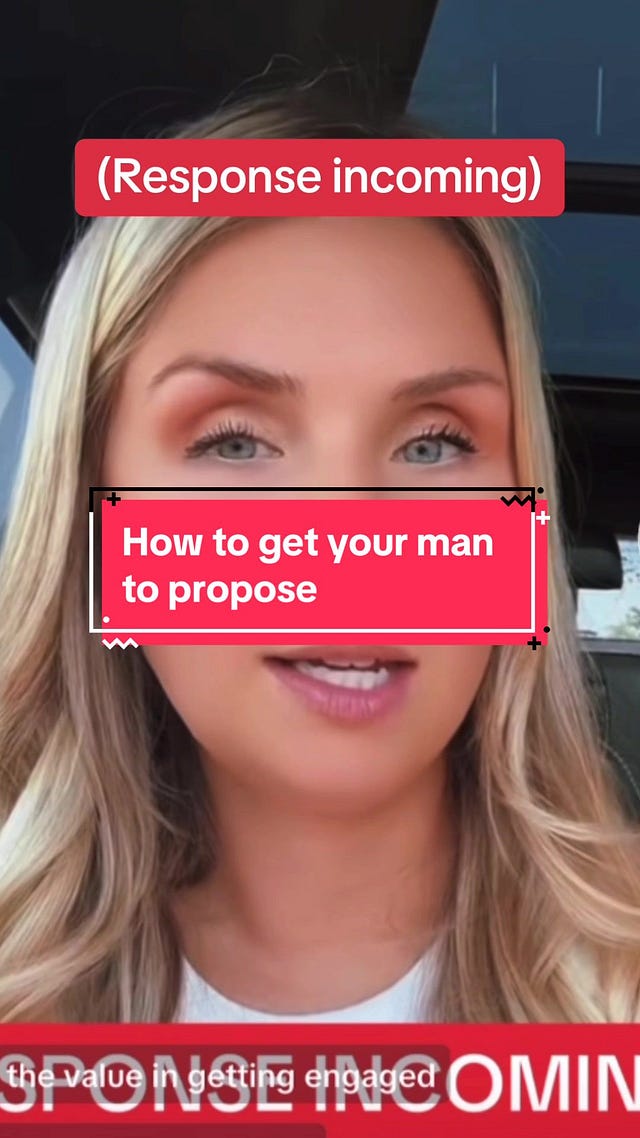
Or this girl who asked the internet at large, “For those of you women who are married, how did you get your significant other to see the value in getting engaged and married?” She said that she’s been with her boyfriend for three years, is dying to get married, but he won’t settle down.
 Tiktok failed to load.
Enable 3rd party cookies or use another browser
Thousands of women chimed in with advice like the girl who stitched this and said, “Hey, I was you, you are me.” She waited for a man for two years and finally had to realize that her desires mattered too, not just his. And if she wanted to get married, then she needed to find someone who wanted to marry her.
Or when the last episode of season one of The Secret Lives of Mormon Wives aired and thousands of women were like “Ok, whoa, Jen, how your husband treats you is not ok. You deserve better.”
Or when millions of people watched the son of a JetBlue billionaire gift his wife an egg apron for her birthday when she’d been asking to go to Greece for years.
Before social media, we only had access to these details of the women’s relationships in our inner most circle, if that. It’s so much harder to detect systemic patterns and see large-scale inequality when you only have a window into such a small sample.
But now? We are detecting systemic patterns together and highlighting large-scale inequality together.
With social media, it’s as if we’ve taken this “prize of a man” out from its box and shone a big ol’ spotlight on it for the world to see. And collectively women are realizing, “Oh, sometimes the prize isn’t so shiny. Sometimes the prize is… kind of embarrassing. Sometimes the prize doesn’t treat us like an equal.”
And now the women are rushing to turn off the spotlight. Because they are embarrassed.
But the spotlight isn’t the problem. The gender inequality in heterosexual relationships is the problem.
And who benefits from putting inequality back in the dark while keeping the spotlight on the status of being chosen? (hint: rhymes with schmatriarchy)
Patriarchy has never wanted women to talk to each other openly about men
One of the earliest written laws we have record of is from the rule of Urukagina from 2400 BC. It states:“If a woman speaks disrespectfully to a man, that woman’s mouth is crushed with a fired brick.”
The Bible is full of warnings for women to stay silent. It teaches that a woman is not permitted to speak in church, that she must obey her husband and never exercise authority over men. When Miriam spoke out against Moses she was exiled.
From the 16th all the way to the 19th century, outspoken women were silenced with a scold’s bridle- a metal muzzle with a tongue depressor.

Women could be forced to wear one for anything from nagging her husband, speaking out against abuse, preaching in public, complaining or voicing a dissenting opinion.
As if to say, you have to have a husband, but shut your trap about any mistreatment.
Guess who that benefitted? Men who mistreat women.
I’m not saying that not posting your embarrassing boyfriend on TikTok is the same thing as wearing a scold’s bridle, but what I am saying is that hiding men’s mistreatment greatly benefits patriarchal supremacy and gender inequality.
As if to say, definitely have a boyfriend, but shut your trap about any mistreatment. That’s embarrassing for you.
(Not for him mind you, but for you.)
Typical patriarchy, charging the woman for a man’s misbehavior. Making her hide in shame while he isn’t embarrassed at all for his own behavior.
I say keep posting the embarrassing boyfriends
So now women are highlighting that they are in a relationship, but hiding the “embarrassing” details.
I wish it were just the opposite. I don’t care to see you’ve achieved the trophy of being chosen, but I do care what your boyfriend said to you last night. I want to see the egg apron, and see a chorus of women asking for more on your behalf. I want to hear the relationship questions and the struggles. I want to hear other women’s response.
I’ve learned so much from women exposing the patriarchy in their lives online. I want to keep learning together.
Times are a-changing. Not because patriarchy has gone away, but because we’ve never had such a bright spotlight illuminating patriarchy before.
Let’s not put patriarchy back in the dark.
Although I will say- the embarrassment is being pushed back. Correct me if I’m wrong high schoolers, but from what I can tell- it’s totally cool to go to homecoming with a group of your girl friends freshman and sophomore year, but then starts to become embarrassing junior and senior year if you don’t have a date. Which I feel like is pushed back from when I was in school where it was cool to go to middle school dances with your girlfriends, but once you hit high school, you wanted a date. Part of me wonders if this whole phenomenon isn’t that having a boyfriend is embarrassing, but that the age at which it’s cool to not have settled down yet is shifting later and later as time goes on. For instance, the author of the article is 29 years old. I wonder if the sentiment would be different and the pressure to partner up would be stronger in her mid-to-late 30s.
Another reason that it would be a huge deal if it really were true that having a boyfriend diminished a woman’s social status: status is like the last thing left that long-term heterosexual relationships offer women. Unlike 100 years ago, a woman doesn’t need to be with a man to have money, property, safety, a bank account or kids. But it still offers status- take that away and men would actually have to offer women something that society didn’t hand them. They would have to offer good companionship. Relationships not based on necessity but purely on making each other’s lives better- that would be new. And exciting!
I’m thinking about how much this shift is still patriarchy at work. Reminds me of the many lessons in church about not gossiping, to “not speak ill of the Lord’s anointed”—aka men, and the constant chiding lessons urging women to “focus on the good” with their spouses. Women are sold these platitudes because it makes women look whiny, catty, and ungrateful, but really it’s to not embarrass the men, and women, for tolerating such a sexist, unequal system.
"I’ve learned so much from women exposing the patriarchy in their lives online. I want to keep learning together.
Times are a-changing. Not because patriarchy has gone away, but because we’ve never had such a bright spotlight illuminating patriarchy before.
Let’s not put patriarchy back in the dark."
Amen!!!🙌🏻